
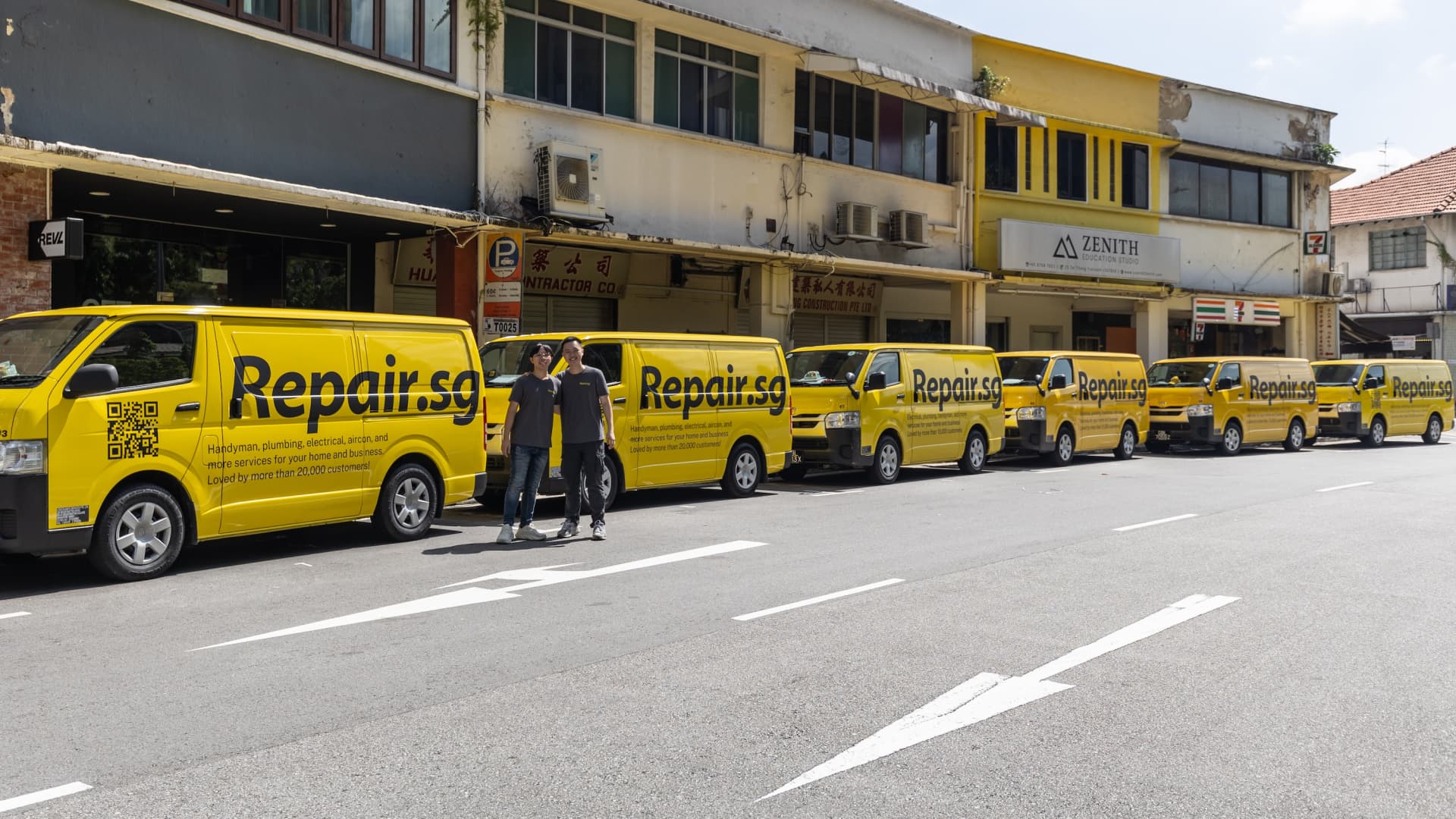
Zames Chew and Amos Chew are co-founders of Repair.sg.
Courtesy of Repair.sg
Growing up, James Chew thought he wanted to work in a white-collar role at a company like Google, but his career took a different turn. Today, the 26-year-old runs Singapore-based handyman service Repair.sg with his 24-year-old brother and co-founder Amos Chew.
In 2024, his Singapore-based company Repair.sg 1.7 million Singapore dollars (about $1.3 million) were brought in, according to documents reviewed by CNBC. make it.
“When I was young, my dream was always to work in big tech,” Chew said. But one day in early 2016, he discovered a gap in the market.
“Our parents were looking for a service provider to fix something around the house,” Chew said. “I was just looking online, and … I didn’t (seem) anywhere to find daytime service providers (online). So I figured … let’s put up a website and see what happens from there.”
So, at the age of 16, Chew spent 30 Singapore dollars (about $23) to buy a website domain name, his father helped him register the business, and Repair.sg was born.
Nearly a decade later, what started as a blue-collar side hustle by two brothers now has more than 20 employees and is on track to bring in about $2.3 million in 2025, according to documents reviewed by Create CNBC.
Starting the side hustle at 16
As kids, the Chew brothers loved being hands-on.
“My brother and I would do everything together. That meant building Legos, building PCs, taking things apart,” Chew said. “(We’ve) always done projects together, and it’s our dream to work together when we’re adults.
Both were able to realize this dream during their teenage years after starting Repair.sg. Chew said the company slowly picked up momentum until the past few years when its growth began to pick up.
For the company’s first three years, the brothers were still in school, so they had to keep busy working for the business between classes or in their evenings.
“What a lot of people don’t know is that there’s a lot of education … (and) licensing behind the services we do, and it goes beyond just picking up a screwdriver and a hammer,” he said. So they spent years acquiring the knowledge, skills and licenses needed to run their business.
Also, before the business grows, they will take on most of the jobs themselves such as changing lights, and fixing furniture. “For the first seven years, maybe until the beginning of 2024, (the business) was basically pretty much dead,” Chew said. “We were young and not very good business owners.”
Chew said that in the early days, he and his brother did anything and everything that people wanted to hire them for, going so far as to set alarms at 4 a.m. to make sure they could respond to initial messages from potential clients.
Throughout this time, there were many hard lessons learned and some jobs they shouldn’t have taken, Chew later said.
“(Maybe) the expectations were completely different, or maybe they were really cheap and it was a pain for us, or … they weren’t very good people,” he said. “We took what came our way because we believed the social belief that we were inferior or not respected, so we were just grateful for what we got.”
It began to grow and scale until 2021 when the two brothers decided to turn Repair.sg from a hobby into a full-fledged business. Both also decided to go to university so they could focus on business instead.
Blue-collar stigma
The Chew Brothers are part of a wave of Gen Zers who are picking up Blue collar Some have more than attended white-collar industries, or university cases.
While both enjoy their work, they have faced a lot of pushback from their parents and strangers alike, Chew said. “Growing up, our parents always (told) us things like: ‘If you don’t study hard, you’re going to do a manual labor job, and it’s going to be horrible. Don’t you want to sit in an office with an air conditioner?'” he said.
“(And) when we started talking (to customers) … they would tell us to our faces: ‘You’re kids. You guys should study in school and not do this kind of thing. This is for people who, quote, unquote, don’t make it in life,'” he said.
Because of the social stigma surrounding blue-collar jobs, Chew says he and his brother tried to keep their business a secret for a while.
“We were always very insecure about what we did, because while we enjoyed it, the negativity got to us. So we made it a point not to announce that we were doing it,” he said.
However, he has now recognized that fundamentally, the work they provide creates great value for customers. Furthermore, he enjoyed the job, and he loved that he worked with his brother—which was ultimately more important than how others viewed his business.

“I’m optimistic for the future of the space,” he said, adding that in the past few years, he’s seen an increase in the number of young people entering blue-collar industries. In fact, Chew says some of his friends have given up their white-collar jobs for blue-collar ones, and “many of them are happier than they ever were.”
“I’m glad I didn’t listen to anyone else and (keep going), because if I was forced to sit in an air-conditioned office five days a week and type on a computer, I don’t think I would feel the same happiness, fulfillment, joy that I do today running this business with my brother,” Chew said.
Want to level up your AI skills? Sign up for the Smarter Make It’s new online course by CNBC, How to use AI to communicate better at work. Get precise hints to optimize emails, memos and presentations for tone, context and audience.